Families rarely start their school search with an application. They begin by comparing practical factors: location, curriculum, grade levels, fees, language support, admissions timelines, and perceived fit. A school directory listing is often the first place that comparison happens. If information is incomplete, outdated, or misaligned with the school's actual admissions process, promising interest can fade before a single conversation begins. For school leaders, the listing is more than marketing. It is a controlled, trackable entry point into the family journey. It must reflect institutional identity clearly, answer early-stage questions reliably, and guide families toward a meaningful next step, whether inquiry, tour, or application. This guide shows international schools what belongs on a directory listing and why completeness matters now.
Latest Articles
Community EngagementFamily EngagementSchool Operations
Family Engagement Software That Keeps Schools Connected
When admissions, finance, academics, and student support operate in disconnected systems, families face fragmentation: repeated data entry, misdirected notices, delayed payment updates, and inconsistent messaging. True family engagement software is more than another app. It unifies workflows around the student and household record. It ensures admissions updates reflect real-time application progress, fee balances sync with finance postings, and wellbeing notes trigger coordinated follow-up. This consistency builds trust, reduces staff friction, improves enrollment confidence, supports timely payments, and strengthens retention, all by making information accurate, accessible, and action-oriented across the entire student journey. This guide explains how international and bilingual schools can choose family engagement software that keeps every department connected to one shared trusted household record from start to end.
School EnrollmentDigital EnrollmentFinance
Digital Enrollment That Keeps School Data Connected
Digital enrollment is more than online forms and e-signatures. It is about continuity across the entire family journey. From first inquiry to active student status, data should flow seamlessly between marketing, admissions, finance, and academic teams. A connected system eliminates redundant entry, reduces manual handoffs, surfaces blockers early, supports multilingual families, adapts to grade- and program-specific requirements, and links admissions decisions directly to financial actions. When records are fragmented across tools, schools lose real-time visibility, delay family communication, and increase operational risk, especially during peak periods or multi-campus growth. The goal is a unified, role-aware workflow that saves staff time while building family trust through clarity, consistency, and control. This guide shows schools how to keep that continuity fully connected.10
Artificial IntelligenceAdmissionsAI in Education
AI Admissions: Better Decisions, Not Faster Rejections
AI in admissions does not replace human judgment. It strengthens it. By automatically checking document completeness, consolidating records from transcripts to interviews, summarizing multilingual inputs, and surfacing context at the right moment, AI helps admissions teams act with greater consistency and clarity. It reduces administrative friction without compromising ethical responsibility. The system flags gaps, prepares reviewers, and improves family communication, but never decides who belongs. That decision remains grounded in professional expertise, contextual understanding, and institutional values. For schools managing complex inquiries across languages, curricula, and campuses, AI's role is operational support, not autonomous authority. This guide explains how international and bilingual schools can use AI for better admissions decisions without turning the whole process into simply faster automated rejections.
Admissions InsightAdmissions FunnelEnrollment
Admissions Funnel Versus Enrollment Funnel Explained
A school may receive strong inquiry and application volume yet still miss its enrollment target. The gap is rarely lack of demand. It is often confusion between the admissions funnel and the enrollment funnel. These are two distinct, interlinked workflows: one measures fit and selection, the other measures commitment, readiness, and activation. They serve different families at different stages, require different teams and data systems, and answer fundamentally different questions: Should this student be admitted? versus Will this student start, and are we ready for them? Without clear separation and intentional connection, schools risk misdiagnosing bottlenecks, duplicating effort, delaying onboarding, and reporting inaccurate yield metrics. This guide explains both funnels and how schools connect them without collapsing them into one.
A Grade 7 math average may appear stable while a subset of students falls behind. Cohort benchmarking helps school leaders spot such patterns early, not to rank, but to connect entry data, academic progress, student experience, and continuity metrics across time. It requires defining purpose-driven cohorts, for example a 2024 Grade 9 intake, multilingual learners, or midyear admits, selecting fair comparison groups, anchoring analysis in consistent baselines, and integrating fragmented data into a unified student record. When aligned with real workflows and leadership questions, it transforms isolated reports into actionable insight, supporting timely interventions, curriculum review, and enrollment strategy. NovaEd ONE enables this by unifying admissions, academics, wellbeing, and re-enrollment in one institutional view for school leaders across multiple campuses.
A prospective parent opens five school websites, compares tuition, checks locations, and reads promises about individualized learning. The school that earns the inquiry is rarely the most visually striking. It is the one that answers the next question clearly, builds confidence, and makes the next step frictionless. This guide focuses on practical conversion: turning anonymous website traffic into qualified family conversations. It shows how international, bilingual, independent, and multi-campus schools align website design with admissions operations, not just marketing. Topics include defining meaningful conversions, structuring pages around real parent questions, optimizing forms for intent over volume, ensuring multilingual parity, mobile-first actions, trust signals, and connecting web data to CRM workflows. Conversion fails when data sits in silos or requires re-entry.
Parents often abandon school applications not due to disinterest, but because of invisible friction points in the process: redundant information requests, unclear next steps, delayed or generic responses, and requirements presented without context or purpose. These experiences create confusion, fatigue, or doubt, leading families to pause rather than withdraw. When schools unify data across departments, stage document collection meaningfully, offer multilingual explanations, and respond with timely, informed messages tied to family-specific intent, many paused applications can resume. This shift turns operational gaps into moments of trust-building and increases enrollment continuity without adding manual workload. This guide shows international and bilingual schools how to find those friction points and restore enrollment momentum with clearer, connected admissions workflows for families every day.
A parent changes a phone number during admissions, but the update never reaches finance, transportation, or the homeroom teacher. An invoice goes to the wrong guardian. Two siblings appear under separate households. At re-enrollment, staff rebuild information the school already collected. These are not isolated administrative errors. They are signs that the school does not yet have a connected family record. Understanding how to centralize school family records starts with a practical shift: family data is not simply contact information. It is institutional context. It connects each learner to guardians, siblings, emergency contacts, authorized pickups, billing responsibility, communication preferences, documents, support history, and the full relationship a family has with the school through one shared governed source of institutional truth.
Student WellbeingPISAStudent Understanding
The PISA Results Are Out. I Keep Thinking About The Other 88 Percent.
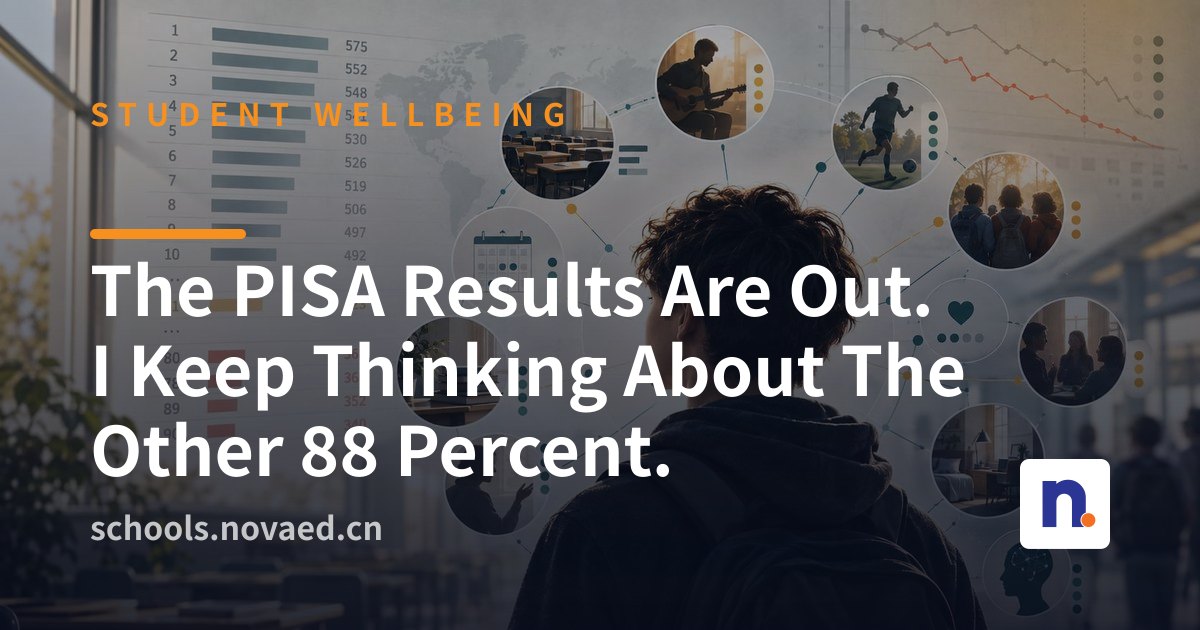
This year's PISA results show socio-economic background accounts for just 12% of the variation in science performance among students within the same country. That means over 88% of the difference stems from factors schools can actually notice and act on: motivation shifts, help-seeking behavior, sense of belonging, classroom engagement patterns, and changes in extracurricular participation. These clues exist in admissions interviews, attendance logs, pastoral notes, activity sign-up lists, and teacher observations, but rarely speak to one another. Understanding a student is not about ranking systems. It is about integrating fragmented insights to support the individual child behind the score. That integration is where meaningful responsiveness begins. This reflection asks what schools can notice when those signals finally connect in practice.