
I have spent enough time inside this market to distrust its favourite word. Everyone in Malaysian international education talks about growth. Growth in school numbers, growth in enrolment, growth in the local share of demand. The figures are real, and I will use them. But the more campuses I visit and the more admissions data I see, the more convinced I am that growth and development have quietly stopped meaning the same thing. Malaysia has proved it can build international-school capacity. The question that will define the rest of this decade is which schools can hold families, teachers, and pricing power once choice becomes abundant. That is a very different test, and not every campus that opened in the last five years is going to pass it.
This report sets out how the market is actually structured in 2026, where competition is intensifying, and what the phase through 2030 is likely to reward. It is written for the people who carry the risk — boards, operators, investors, and the senior leaders who have to make occupancy targets real — and for the families trying to navigate a market that has become far larger and far noisier than it was a decade ago.
The Numbers Everyone Quotes, And What They Actually Mean
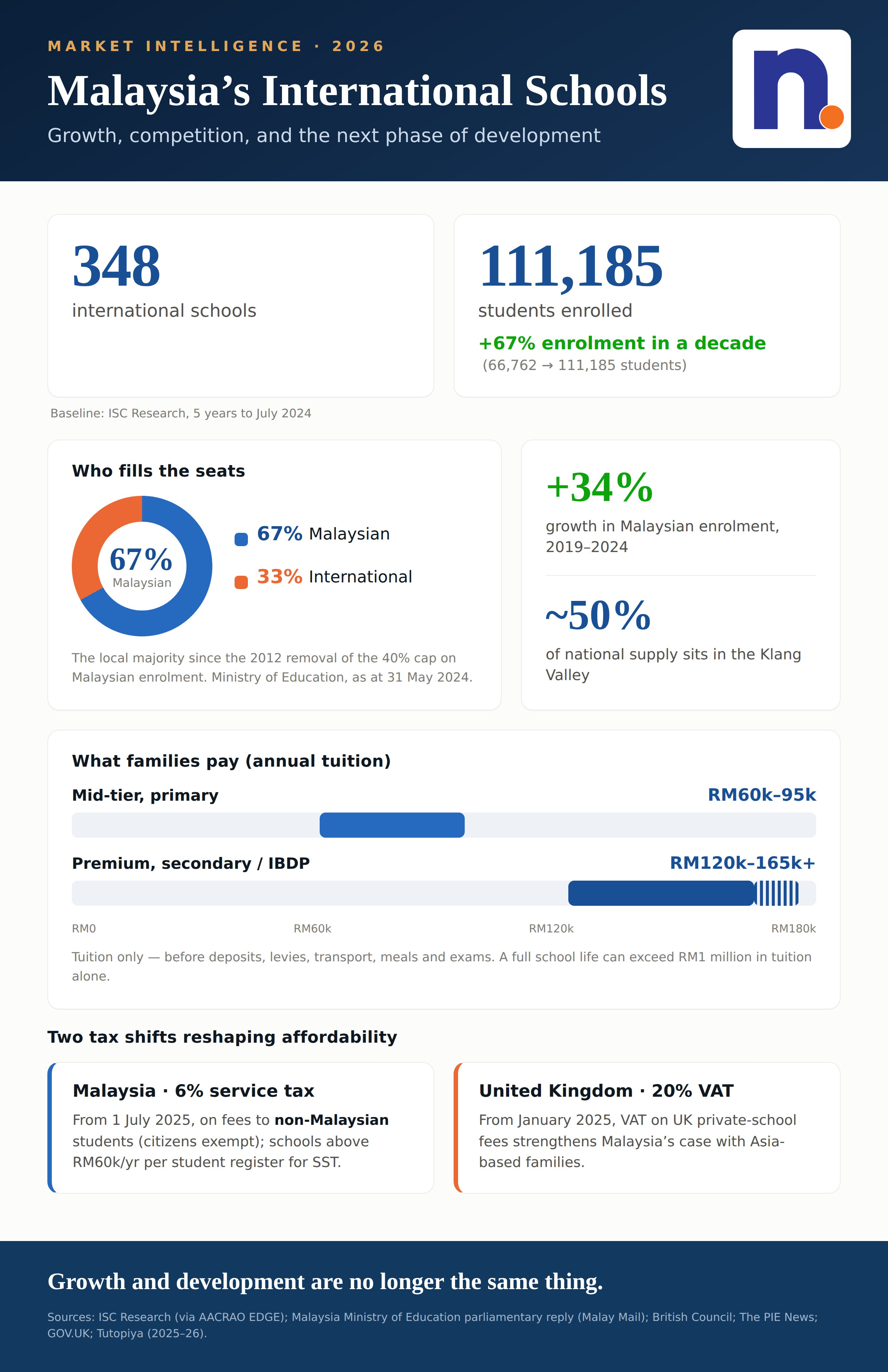
The most widely cited independent baseline comes from ISC Research. Its snapshot for the five years to July 2024 put Malaysia at roughly 348 international schools teaching about 111,185 students, with both school numbers and enrolment up around 11% over that period. Widen the lens to a decade, and the expansion is more striking: ISC Research reported enrolment rising about 67%, from 66,762 students to 111,185. Those numbers place Malaysia among the larger English-medium international-school markets in Southeast Asia, and they are the reason the industry conversation has moved from scarcity to competition.
Malaysia's own official figures tell a related but not identical story, because the government defines “international school” more narrowly than ISC Research does. A written parliamentary reply from the Ministry of Education put international-school enrolment at 88,951 as at 31 May 2024. Of those, 67.1% — 59,688 students — were Malaysian citizens, and 32.9% — 29,263 — were non-citizens. The Ministry also reported that citizen enrolment in international schools rose 34% between 2019 and 2024.
I want to be precise about the gap between those two datasets, because it is routinely misread. ISC Research's 111,185 and the Ministry's 88,951 are not in conflict. They are counting slightly different populations under slightly different definitions. Treat the divergence as a reminder that in this market, sizing depends entirely on where you draw the line — not as evidence that someone is wrong. What both sources agree on is direction: capacity grew, enrolment recovered strongly after the pandemic, and then kept climbing. That much is settled.
The Local Majority Is The Real Story
If you take one commercial fact from this report, take this one. Malaysian families are now the structural demand engine of the market, and everything else follows from it.
The structural break came in 2012, when the government removed the 40% cap that had limited Malaysian enrolment in international schools. Before then, a school's local intake was capped by regulation. Once that ceiling came off, the growth logic of the entire sector changed permanently, and the Ministry's own numbers show the result: a settled local majority of just over two-thirds, and Malaysian enrolment growing a third in five years.
This does not mean the expatriate premium has disappeared. Selected campuses in the right catchments still run high international mixes — the International School of Kuala Lumpur has described a community of more than 1,750 students from over 70 nationalities, around 87% of them international, with no single nationality above a quarter. Destination boarding schools skew international too; Epsom College in Malaysia has described a roughly 65% international student body drawn from around 30 nationalities. Those profiles matter enormously to the schools that hold them, because they are hard to replicate and they justify a premium. But they no longer describe the national average. Across the system, it is Malaysian parents wanting English-medium instruction, portable qualifications, and clearer university pathways who set the volume.
What I take from this as an operator is simple: the marketing that still treats “international school” as shorthand for “school for expatriates” is describing a market that stopped existing more than a decade ago. The families deciding occupancy in most catchments are local, discerning, price-aware, and comparing you against a mid-market that barely existed when the quota came off.
One Country, Several Markets
It is a mistake to talk about “the Malaysian market” as a single thing. It is a set of regional micro-markets linked by national regulation, a shared teacher pool, and overlapping parent expectations — and the differences between them are commercial, not cosmetic.
Roughly half of the national supply sits in the Klang Valley, where Mont Kiara, Ampang, Petaling Jaya, Subang Jaya, Shah Alam, Cyberjaya, and Putrajaya form overlapping catchments shaped as much by traffic and housing as by pedagogy. Penang is the clearest second hub. Johor Bahru and Iskandar Puteri sit inside a genuine cross-border market with Singapore, where families weigh Malaysian fee levels against Singaporean proximity and branding. And boarding corridors such as Bandar Enstek convert two quite different demand streams — domestic weekly boarding and regional full boarding — into enrolment that no ordinary day-school catchment map can explain.
The practical consequence is that national averages are close to useless for decision-making. A fee level that looks competitive against the national picture can be badly exposed inside a single Klang Valley corridor already crowded with near-identical offers. When I look at a campus, I want to see its catchment, not its country.
The British-Pathway Crowding Problem
Curriculum supply still tilts heavily toward British and Cambridge pathways, which continue to dominate parent recognition, secondary examination routes, and university counselling oriented to the UK. The International Baccalaureate, American and Advanced Placement programmes, Canadian and Australian pathways, and various bilingual and national-system models all compete within that landscape rather than replacing it.
The commercial effect of that dominance cuts both ways, and this is why I think a lot of operators fool themselves. British-pathway familiarity clearly supports demand. It also produces lookalike competition in the densest fee bands, where schools with almost interchangeable marketing language and adjacent offers end up competing on discounting, enrichment packaging, and conversion tactics rather than on any genuinely different educational proposition. Brand adjacency, sitting near a famous name, borrowing its vocabulary, feels like a strategy. It is not one. Families who understand this dynamic can shortlist far more intelligently than the marketing invites them to, and increasingly they do.
What Families Actually Pay
Fees make the same point in harder numbers. Mid-tier international schools in the Klang Valley commonly charge in the region of RM60,000 to RM95,000 a year at the primary level, with secondary and IB Diploma years running higher. At the top of the market, premium secondary and IBDP fees now reach roughly RM120,000 to RM165,000 or more per year, depending on the school and year group.
Tuition is only the visible part of the commitment. Across a full school life from early primary to pre-university, a household can easily commit well over RM1 million in tuition alone before deposits, capital and development levies, transport, meals, uniforms, examinations, technology charges, and co-curricular costs are counted. Against Singapore, Hong Kong, or UK boarding, those Malaysian fees still read as value, which is exactly why regional families, and households linked to the Malaysia My Second Home (MM2H) residency programme, remain part of the demand story. Against ordinary Malaysian household income, the same fees are a serious premium that now competes with a much wider mid-market offer than existed a decade ago.
The Tax Story Is More Subtle Than The Headline
Two tax changes have reshaped the affordability conversation, and both are routinely reported too bluntly. Getting them right matters, because families and boards are making decisions on the basis of the headlines.
The first is domestic. From 1 July 2025, Malaysia extended its service tax to private education services at a rate of 6%. But the detail is what counts: the tax is applied to fees charged to non-Malaysian students, and Malaysian citizens are exempt. Schools charging above RM60,000 per year per student fall within the Sales and Service Tax registration net. So the widely repeated shorthand — “Malaysia now taxes premium school fees” — is misleading. The measure lands squarely on the foreign-student segment and on transnational-education arrangements, not on the local majority that actually drives volume in most catchments. For a school whose enrolment is predominantly Malaysian, the direct fee impact is far smaller than the headlines suggest; for a school leaning on international families or cross-border programmes, it is a real competitive variable. The British Council has already flagged the risk to price-sensitive international students and UK transnational programmes.
The second change runs in Malaysia's favour. From January 2025, the United Kingdom applied 20% VAT to private school fees. Malaysian operators selling against UK boarding have been quick, and in my view correct, to make the comparison — Epsom College in Malaysia has publicly positioned itself as a fee “lifeline” for UK families reconsidering domestic boarding. Lower headline fees, English-medium continuity, and a credible boarding product give Malaysia a stronger case with Asia-based families who once defaulted to Britain or Australia.
Put the two together, and the picture is not “Malaysia got more expensive.” It is that total-cost transparency has moved to the centre of the admissions conversation. Parents in 2025 and 2026 are less impressed by list tuition and far more attentive to the full attendance cost, sibling-discount architecture, deposit refundability, and whether a school can justify its premium with evidence rather than facilities theatre. Schools that communicate fee logic poorly lose families who would otherwise have stayed in consideration. Schools that can show class-size reality, learning-support capacity, destination data, and pastoral continuity keep their pricing power longer. I have watched both outcomes happen in the same corridor, in the same admissions cycle.
Growth Is Not The Same As Occupancy
Here is the uncomfortable part, and the reason I opened this report the way I did. The five-year expansion to 2024 showed that school openings can keep pace with enrolment growth. Parallel growth is not automatically healthy growth. It can hide weak occupancy on individual campuses — especially newer openings that entered saturated corridors or fee bands already crowded with interchangeable British-pathway offers.
Through 2025 and into 2026, the contested ground has shifted from opening campuses to filling and keeping them: enquiry-to-enrolment conversion, re-enrolment and retention, specialist secondary staffing, and the ability to differentiate beyond a good campus tour. Education groups intensify that pressure, because shared admissions systems, procurement, and brand architecture can compress unit costs in ways an independent school cannot match. Independents, in turn, defend on community intimacy and leadership visibility — assets that are real but harder to scale.
Closures and quiet consolidations attract far less attention than ribbon-cuttings, but the vulnerability is real wherever high fixed costs meet thin differentiation and chronic discounting. The strategic question for a board in 2026 is no longer whether Malaysia can support international schools. It plainly can. The question is which specific campuses can sustain contribution margin after staffing, compliance, facilities, and acquisition costs are honestly counted. That is a campus-level question, and the national growth story cannot answer it.
Teachers Are The Real Constraint
Underneath almost every other issue sits talent. A weaker ringgit has made Malaysia a harder sell for some UK-recruited teachers, weighing take-home value against Singapore or Gulf hubs, even as experienced expatriate educators in premium schools remain well compensated. Local talent development, middle-leadership pipelines, and retention packages, therefore, matter more with every campus that opens.
This is the constraint I would watch most closely if I were investing. You can build facilities faster than you can build an expert secondary department, an inclusive-education capability, or a stable pastoral system. That imbalance, buildings outrunning people, will decide which schools can grow their year groups through 2027 without eroding the quality story that won them their families in the first place.
What The Next Phase Rewards
Looking from mid-2026 toward 2030, I expect Malaysia's market to mature through differentiation rather than through more undifferentiated expansion.
Quality bifurcation should become more visible as parents tire of similar marketing language and start asking harder questions, about safeguarding, wellbeing, learning support, teacher turnover, and verifiable university destinations. Fee-band specialisation should matter more than another wave of mid-market lookalikes. Malaysia's regional education-hub narrative, lower cost than Singapore, English-medium continuity, boarding capacity, and links into higher education, will stay credible only if quality signalling stays consistent. Group consolidation is likely to continue, but campuses that feel interchangeable inside a centralised brand will meet parent scepticism. And the schools that treat admissions and retention as a data-led operation, rather than as seasonal marketing, will pull away from those that do not.
For operators, boards, and investors, my read is disciplined optimism. Malaysia remains genuinely attractive by regional standards: local demand is deep, curriculum infrastructure is established, multiple geographic hubs exist, and boarding gives the market a mobility story that pure day-school cities lack. But attractiveness is not the same as easy returns. National averages hide catchment-level oversupply. Brand entry is not the same as sustainable margin. Retention, teacher stability, and evidence of learning quality are becoming the core assets of the next cycle, and they are the assets that are hardest to buy quickly.
For families, market maturity is an advantage if it is used carefully. More schools mean more genuine options across curriculum, location, size, and budget. They also mean more noise. The families who navigate Malaysia well from here will start with the constraints that actually govern the decision: total annual cost, commute or boarding readiness, curriculum-to-destination logic, support needs, and the culture in which a particular child sustains confidence, before they fall for a campus tour. A brand shortlist is only useful after those filters are clear.
By 2030, I expect this sector to look less like a boom market defined by openings and more like a contested professional market defined by occupancy quality, talent depth, fee integrity, and provable student outcomes. The expansion era proved that Malaysia can grow its capacity. The next phase will prove which institutions can hold families and teachers when choice is everywhere. Those are not the same achievement, and pretending they are is how good money gets committed to campuses that were never going to hold their catchment.
That distinction, between building a school and sustaining one, is the thread running through everything NovaEd covers, and it is why we built the Directory the way we did: to help families and operators see past the brochure to the evidence.
Sources and Notes
- School and enrolment counts (≈348 schools; 111,185 students; +11% over five years to July 2024; +67% over the decade from 66,762): ISC Research, as reported by AACRAO EDGE and ISC Research's Malaysia report. ISC Research has since published an updated five-year-growth snapshot to July 2025; figures above use the well-corroborated July 2024 baseline.
- Ministry enrolment (88,951 as at 31 May 2024; 67.1% / 59,688 Malaysian; 32.9% / 29,263 non-citizen; +34% citizen enrolment 2019–2024): Ministry of Education written parliamentary reply, as reported by Malay Mail.
- Removal of the 40% cap on Malaysian enrolment (2012): British Council.
- Malaysia service tax on private education (6% from 1 July 2025; applies to non-Malaysian students, Malaysian citizens exempt; SST registration threshold RM60,000 per student per year): The PIE News; British Council.
- UK 20% VAT on private school fees from January 2025: UK Government (GOV.UK). Epsom College in Malaysia fee positioning: School Management Plus.
- Fee ranges (mid-tier primary ≈RM60,000–95,000; premium secondary/IBDP ≈RM120,000–165,000+): Kuala Lumpur international-school fee comparison, Tutopiya, 2025–2026.
- Individual-school profiles (ISKL; Epsom College in Malaysia) reflect each school's own published descriptions and should be re-verified against current school sources before republication.